Friday, March 31, 2023

Lady in the Water


Lady in the Water (Original Motion Picture Soundtrack)
Music Composed by James Newton Howard

Coming up from Renovatio Records, we have another release from the M. Night Shyamalan-James Newton Howard duo: the score for the 2006 fantasy thriller Lady in the Water, starring Bryce Dallas Howard, Paul Giamatti, Bob Balaban, and Jeffrey Wright. Advertised as a “bedtime story”, the film’s plot tells the tale of Cleveland Heep, a Philadelphia apartment complex superintendent who one night stumbles upon a young woman in the swimming pool. He and his neighbors soon realize that the woman is in fact a Narf -a sort of water nymph-, named Story, who is on a quest to find The Author, a writer that will make great changes to the world through his work. However, Story’s life is in danger since she is being stalked by a mythical wolf-like creature called a Scrunt that tries to prevent her from returning to her watery home, the Blue World. To save herself, she needs help from a team of people -a Symbolist, a Guardian, a Guild and a Healer-, and it turns out that some of the kindhearted residents of the apartment complex may well be these gifted individuals without them knowing it.

While its premise is indeed interesting, and several of its technical aspects are spot-on, the film was a critical and financial failure. Much of the criticism was directed at the self-indulgence with which Shyamalan cast himself as The Author, pretentiously giving the impression that his writing is of immense value to the world. The theme of the film deals with the fact that every person in life has a reason to exist and a profound spiritual purpose, but Shyamalan himself playing this character results in the message being cheesy and a bit laughable. Also, Balaban plays a movie critic, a character that is in the movie to suggest how inconsequential and misguided are cynicism and the inability to openness when faced with extraordinary events. However, the character is presented with such poor taste that it ends up being no more than a jab to those who do not like Shyamalan’s films. All in all, Shyamalan’s ideas for Lady in the Water are very intriguing but poorly executed, making it difficult for audiences to take the film seriously and, alas, hardly achieving an effective suspension of disbelief.

Nevertheless, one of the aspects in which the movie excels is in its score. By the time James Newton Howard tackled this movie, he had collaborated with the director four times already, providing high quality scores for all four of them. Lady in the Water is no exception as the composer seems to have been greatly inspired by the fantastic elements of Shyamalan’s script. While it does have some similarities with those previous scores and many of Howard’s mannerisms, Lady in the Water stands out in harmony, orchestration and thematic authenticity, providing everything you would expect to hear from a fantasy score. Howard’s score is both a delight in its ingenious instrumentations, and in its thematic richness. But the standout quality of the score is its undulating rhythm, perfectly and fittingly encompassing the constant movement of water. Howard effectively plays around with the rhythm, intensifying it for specific scenes in which characters progress in their search of truth and meaning (as in the compelling cue “Charades”), or lessen it to build a menacing sense of momentum and intrigue (as in the ominous cue “The Party”). Pretty much every track has a constant feeling of motion, while showcasing remarkable choices of instrumentation. For the Blue World, Howard resorts to soft strings, chimes, harps, celestes, woodwinds and distant choirs, contrasting this with the bass-heavy sections of the orchestra for the dangerous threats of the story. Choir is quite omnipresent in the score, with high female vocals at times subtly accompanying the ensemble, while at other times exploding and taking the lead in big moments of awe.

As expected, Lady in the Water is richly thematic. The opening track “Prologue” works as a small introductory suite, hinting at the main themes that will be explored throughout the score. The magnificent title theme for Story and the Blue World is a simple 6-chord progression that is repeated in most of the cues, from slight treatments by piano and celesta to robust full-ensemble performances. This theme is quite basic in its harmony but it is instantly recognizable and so hopeful and enjoyable that it brings pure joy each time it appears. The Scrunt also receives its own themes and motifs. An ominous and dark fantasy theme appears for the first time the Scrunt makes its appearance during the second half of the “Scrunt” cue. Similarly, in Jaws fashion, the cues “Story in the House” and “Giving the Kii” introduce a scary low key effect that resembles a distant howling, suggesting the presence of the Scrunt without it being on screen. But the most notable motif for the Scrunt is a strong brass descending 4-chord progression of ferocious evil that is introduced in the mid section of the “Prologue” cue and revisited throughout the entire score. Giamatti’s character is also treated with a theme, a tender motif that first appears during “Cleveland”. This theme is usually performed on woodwinds, soft strings, and it represents the troubled life of the titular character who is desperate to find a new meaning in life after losing his family. The theme is fittingly reprised in full form in piano and strings at the “End Titles”, when Cleveland finally understands his purpose thanks to Story, giving closure to his character arc. There are also some interesting small motifs for flutes in the first half of the score, predominantly in cues like “Ripples in the Pool”, “Scrunt”, and “Story in the House”, which help enhance the fantasy and mystery qualities of the film, almost as a siren’s call that draws characters into the story.

The score for Lady in the Water is generally remembered by film music enthusiasts for offering a number of standalone tracks that are some of the best that Howard has produced in his career. “Charades” is a perfect example of this, an impressive feel-good track that encapsulates the movement of water idea by means of small swirling motifs that are passed around through different sections of the orchestra as the track develops. On top of that, Howard expertly intertwines his main theme, building a track that will have you hitting the repeat button several times. Howard saves the best for the last though, with the outstanding “The Great Eatlon”, a phenomenal cue that displays Howard’s mastery at writing orchestral action music. This track begins with a build up that culminates in a strong ensemble performance of the main Scrunt theme, and later progresses into a full action mid section that exhibits complex layers of brass, strings and choir, before finalizing with two consecutive beautiful performances of the main Blue World theme, first with the entire orchestra and choir, and then with a gorgeous quiet choral performance that rounds up the cue. Here, Howard finally releases the tension that he has built up during the whole score, providing a payoff of orchestral and choir beauty in their full glory that is hair-raising as it is cathartic.

The official album presentation for Lady in the Water was provided by Decca Records back in 2006. This release only offered approximately 40 minutes of score, out of the 70+ minutes of music recorded for the film. Missing from the album were significant cues from the first and second act of the film. Furthemore, the release was further harmed by the inclusion of four Bob Dylan cover songs at the end that are largely skippable and really break the overall listening experience. This new assembly put together by Renovatio Records provides almost 20 minutes of unreleased music, and in chronological order so that the story-telling aspect of the score can be further appreciated.

James Newton Howard is known for having produced high quality scores throughout his career, but Lady in the Water may well be regarded as one of his top 5 best scores to this day. It is never too late to revisit film music at its finest.


Track Listing:
1. Prologue (2:51)
2. Cleveland (1:50)
3. Ripples In The Pool (1:48)
4. Scrunt (2:33)
5. Story In The House (3:31)
6. The Blue World (4:23)
7. Giving The Kii (1:47)
8. Charades (5:53)
9. Revelations (1:38)
10. Cleveland, Run! (2:06)
11. Book Confession (4:04)
12. The Party (6:38)
13. The Symbolist (2:31)
14. The Healing (3:56)
15. The Great Eatlon (4:58)
16. End Title (3:50)

Total Running Time: 54:17


Cover Artwork:


Friday, March 3, 2023

Unbreakable


Unbreakable (Original Motion Picture Soundtrack)
Music Composed by James Newton Howard

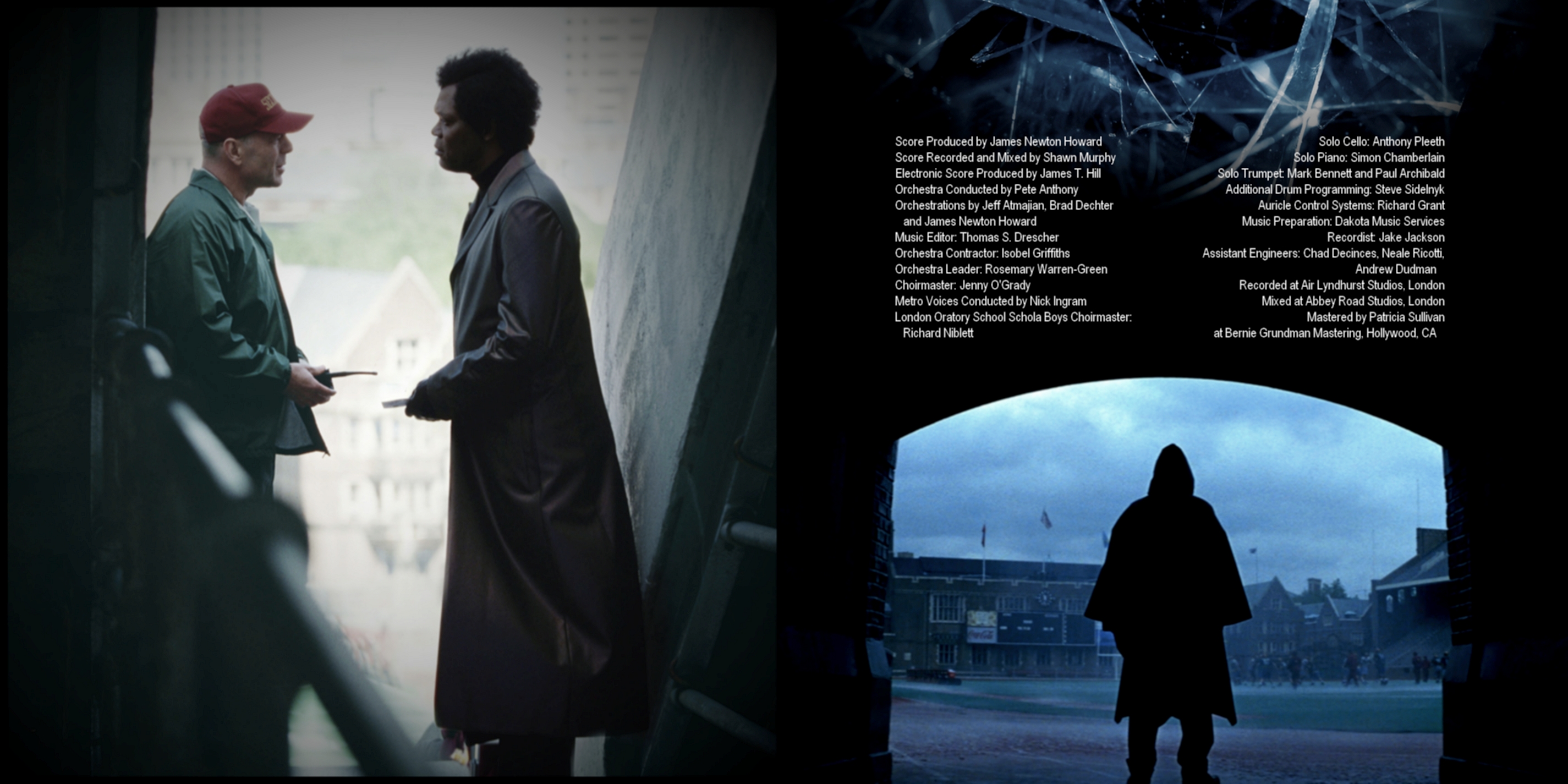
Our next release is James Newton Howard’s score for the 2000 psychological superhero thriller film Unbreakable, written and directed by M. Night Shyamalan and starring Bruce Willis, Samuel L. Jackson, Robin Wright and Spencer Treat Clark. Willis plays David Dunn, the only survivor of a catastrophic train crash with no injuries whatsoever. When David realizes that he has never been ill in his life, he seeks help to understand what is happening to him. This eventually puts him in contact with Elijah Price (Jackson), a disabled comic book store owner who suffers from a genetic disorder that results in his bones breaking easily. As the story progresses, both characters find themselves entangled in a good versus evil fable, eventually understanding their roles in it. The film received much praise for its direction, screenplay, cinematography and performances, ultimately becoming the first installment of a film series that includes Split (2017) and Glass (2019). For the film’s music, Shyamalan returned to James Newton Howard, after their successful collaboration in The Sixth Sense, and Howard provided a score that also received much attention for its contribution to the film’s suspense, particular atmosphere and emotional weight.

While retaining much of the atmospheric appeal of The Sixth Sense, Howard is a lot more ambitious in Unbreakable, expanding thematic and instrumental ideas striving for a tone that would give the film its singularity. As the composer put it, Shyamalan “wanted something that was very different, very distinctive, that immediately evoked the movie when people heard it”. Even tough Unbreakable progresses with minimized instruments and orchestrations, with strings, trumpets and piano taking most of the foreground, Howard does achieve the singularity that his fellow director was after. In the track "Unbreakable", Howard introduces a main theme that immediately hooks the listener’s attention, and serves as an overarching identity for the supernatural element of the story. Starting with a solemn five-note piano motif, the track progressively evolves into a full string ensemble rendition of this theme accompanied by a heavy “new age” drum loop, with choral effects to add to the dark and mysterious atmosphere of the film. The track grows louder and more prominent, elevating the theme with dramatic effect, as if embodying the larger-than-life scenario in which the protagonists find themselves living. This theme is again presented with the drum loop in highlight track “Visions” and at the end in the end credits suite “They Call Me Mr. Glass”.

The David Dunn character is treated with a “hero theme”, subtly introduced with strings and piano at the end of the track “Memories”. The theme is further explored with effective trumpet solos and some comedic delicacies during the “Weightlifting” track, as David continues on his journey of self-discovery. Howard wisely reserves the magnificent and muscular full statements of this theme for “The Wreck” and “The Orange Man”, in which David becomes fully aware of his superhero abilities and his place in the story. On the other hand, the Elijah Price character is fittingly treated with a collection of reflective and fragile high note motifs for strings, piano and harp instrumentations, best summarized in “Prologue”, “Reflections of Elijah”, “Falling Down”, and the beginning of “They Call Me Mr. Glass”.

The score for Unbreakable was released in 2000 by Hollywood Records. Though thoroughly enjoyable, the album was oddly arranged, with tracks out of chronological order, causing it to drag in its mid portions. Now, Renovatio Records has produced a new program that presents the standout cues in fitting chronological order, enhancing the listening experience as Howard’s develops his excellent themes and motifs as the film progresses. We hope you enjoy what is easily one of Howard's best scores for director Shyamalan. Are you ready for the truth?


Track listing:
1. Prologue (1:03)
2. Unbreakable (3:18)
3. Reflection of Elijah (4:07)
4. Memories (2:23)
5. Falling Down (2:34)
6. Weightlifting (3:45)
7. Second Date (1:31)
8. The Wreck (3:51)
9. Visions (5:56)
10. The Orange Man (4:24)
11. Carrying Audrey (1:49)
12. They Call Me Mr. Glass (7:53)

Total Running Time: 42:34


Cover Artwork:


Thursday, February 2, 2023

Avatar


Avatar (Original Motion Picture Soundtrack)
Music Composed and Conducted by James Horner

Here at Renovatio Records, we wanted to start 2023 with a bang, so our first release of the year is the score for the blockbuster Avatar by late composer James Horner. Directed by James Cameron and starring Sam Worthington, Zoe Saldaña, Stephen Lang, Michele Rodriguez, Giovanni Ribisi, and Sigourney Weaver, the 2009 film is an epic science fiction set in the mid-22nd century, when humans are colonizing the habitable moon Pandora in the Alpha Centauri star system with the purpose of mining the mineral unobtanium. Conflict arises when the mining colony threatens the local indigenous tribe of the Na’vi, a race of blue-skinned humanoid creatures who, as expected, do not enjoy having the humans exploiting their beautiful planet. Sam Worthington plays Jake Sully, a disabled corporal sent to Pandora as part of the Avatar Program, which sees humans operating genetically engineered Na’vi bodies remotely with their brains, to infiltrate and interact with the natives of Pandora. While on an expedition in the Pandoran forests, Jake’s avatar is attacked by wildlife and rescued by Neytiri (Saldaña), a female Na’vi who takes him to her clan and teaches him of their customs. Soon, Jake sees himself torn between his military duty and his new found love and respect for the aliens.

Even though the plot is quite simple and modeled after the American interactions with Iraq in the 2000’s, the film is thought-provoking in regards to environmental awareness while also delivering on cinematic action. Drawing concepts from works such as Dances with Wolves, Pocahontas, and even Starship Troopers, the film asks audiences to examine their views and prejudices on deep topics such as colonization, facism, obliteration of native cultures, and exploitation of natural resources. At the time of its release, Avatar quickly became the highest-grossing movie of its time, while also being highly praised for its groundbreaking visual effects, which makes extensive use of motion capture filming techniques –achieved in cooperation with Weta Digital. Furthermore, the film was so successful that Cameron went on to develop four more sequels, the first of which (Avatar: The Way of Water) was recently released in late 2022 and once more broke various box office records.

Also the recipient of much attention was Avatar’s musical score, for which Cameron turned to James Horner. The two had previously collaborated on Aliens (1986), an infamous and unpleasant assignment for Horner, and on Titanic (1997), for which Horner earned an Academy Award. For Avatar, the composer devoted eighteen months of work to develop a sound palette that would represent the Na’vi culture and the visual bioluminescence of Pandora. And it shows, for the result is one of Horner’s most distinguishable scores, not only because of its unique and captivating sounds, but also because it remains a solid representation of Horner’s musical career and contributions to the world of film music. The score works as a sort of "Greatest Hits" compilation; you will hear snippets and nods to several of Horner’s previous scores such as The Four Feathers, Troy, Aliens, Titanic, Mighty Joe Young, Apocalypto, among many others. To get an early idea of what is to come, Horner introduces his effective signature four-note danger motif within the first minute of the first track “You Don’t Dream In Cryo”, a motif that is later used prominently in the second half of the score to accompany the death of nature provoked by the greedy humans. Horner’s detractors may jump on this "recycling" approach, but one cannot deny that the composer kept raising the bar with each new assignment, showcasing his impressive dramatic sense and masterful compositional skills. That being said, Avatar is a richly thematic score. Horner introduces his main theme for Avatar in the latter half of “Jake Enters His Avatar World”, and it consists namely of a series of four chord progressions, which are a stripped variation of Titanic’s love theme. This idea is listened throughout the score, sometimes in the form of humble violin, woodwind and synth performances (“Pure Spirits of the Forest”), and also played by the full ensemble in “Become One Of The People”. It is in this track that Horner fully depicts his intentions with this chord progression, making it part of a larger theme. The progression represents Jake’s growing love for the beauty and nature of Pandora, which is later combined with the discovery theme introduced by a solo boy’s voice in “Become One Of The People”, a montage cue which shows Jake learning of the customs and lives of the Na’vi. The main four-chord idea goes on to eventually cement itself as Avatar’s love theme, as Jake and Neytiri bond and become in love.

There are two more prominent themes in the score, one representing the Na’vi culture, which is very derivative of Horner’s main theme for The Four Feathers. The theme is introduced in full at the beginning of “Becoming One With Neytiri”, and is further explored during the “The Destruction of Hometree”, before becoming the Na’vi’s battle theme in “Gathering All the Na'vi Clans for Battle”, where it generates momentum during the first half and then reaches a full orchestral climax that will sends shivers down your spine. This theme is later used effectively during the battle sequences of the film’s climax, to highlight the heroic yet futile efforts of the Na’vi’s to fight with the technologically advanced humans. The other main idea is an ascension theme that is first heard during “Climbing Up Iknimaya”, on children’s choir and percussion, and then on the glorious “Jake’s First Flight”, with the love theme effectively playing as an interlude. The ascension idea is related to Jake’s assimilation of the Na’vi culture, as he rediscovers his purpose in life. This theme fittingly appears at the end of the film when Jake fully embraces the Na’vi culture and becomes one of them, in mind and in body. These three main identities and the way Horner intertwines them with one another speak of how complex and subtle the composition for Avatar is, narratively accompanying Jake’s journey and quickly captivating the listener, the same way the film visuals captivated the audiences. Horner’s four-chord progression alone is so pleasant and appealing that you cannot help but to wait for it to reappear throughout the score. This once more shows the composer’s talent to capture the essence of a film and its scenes, even when using the same techniques and instruments he resorted to many times in his career.

Things turn sour in “Diplomacy Fails”, when the human’s menacing force starts to become more and more apparent, with brass and militaristic snare taking the lead. By the time we reach “Shutting Down Grace’s Lab”, the aftermath of the human’s greed strikes like an arrow through your chest, with haunting vocalizations accentuated by the four-note danger motif expressing a mournful sense of overwhelming tragedy. After the force generated by “Gathering All the Na'vi Clans for Battle”, we enter into 20 minutes of rousing action music, comprised by “War”, “Quaritch Down” and “Fight To The Death”. The battle music displayed here indeed has themes and motifs battling each other, a clear example being the way in which the Na’vi battle theme establishes itself as a response to the military motif at the 0:50 mark of "War". While the action passages are far overshadowed by the romantic side of the score, they are certainly impressive and rank among the most thoughtful action material Horner has ever written.

The score ends with the pop song “I See You” by Leona Lewis, with the score introduction by Horner, as heard in the film. Though criticized for having too much post-processing, the song actually makes an interesting use of the discovery and love themes, its chorus being the already well-established four-chord progression.

Back in 2009, the score for Avatar received two album presentations by Atlantic Records, one being a regular physical CD release, and the other being a Deluxe digital release with 20 additional minutes of music. Though both releases are quite generous in the amount of music they provide, the first one lacked most of the cues from the climax, and the second one presented the new additions at the end of the album, disrupting the listening experience. This new release by Renovatio Records addresses these issues and provides new unreleased music, as well as film versions of several cues, all presented in chronological order in the form of a 2-CD presentation. The program has namely the film’s first act in CD 1, focusing on Jake’s journey of falling in love with Pandora and Neytiri, while the conflict and action cues are mostly reserved for CD 2. We kindly invite you to revisit Pandora once more with this new album. You will see that there is still plenty to admire.

Track Listing:

CD 01:
1. You Don't Dream In Cryo (6:06)
2. Jake Enters His Avatar World (5:48)
3. Pure Spirits Of The Forest (8:15)
4. The Floating Mountains (3:00)
5. Becoming One Of The People (3:09)
6. Night Iridescence (3:36)
7. Climbing Up Iknimaya (4:04)
8. Jake's First Flight (5:24)
9. Becoming One With Neytiri (4:47)

CD 02:
1. Diplomacy Fails (4:39)
2. The Destruction Of Hometree (6:28)
3. Shutting Down Grace's Lab (2:46)
4. Gathering All The Na'vi Clans For Battle (5:11)
5. War (8:51)
6. Quaritch Down (4:27)
7. Fight To The Death (4:43)
8. A New Beginning (3:25)
9. I See You (Theme From Avatar)* - Performed by Leona Lewis (5:19)
*Includes score introduction by James Horner

Total Running Time: 79:58


Cover Artwork: